Ayodhya Ram Mandir Donation Row: Supreme Court Petition Seeks Financial Audit and CBI Investigation
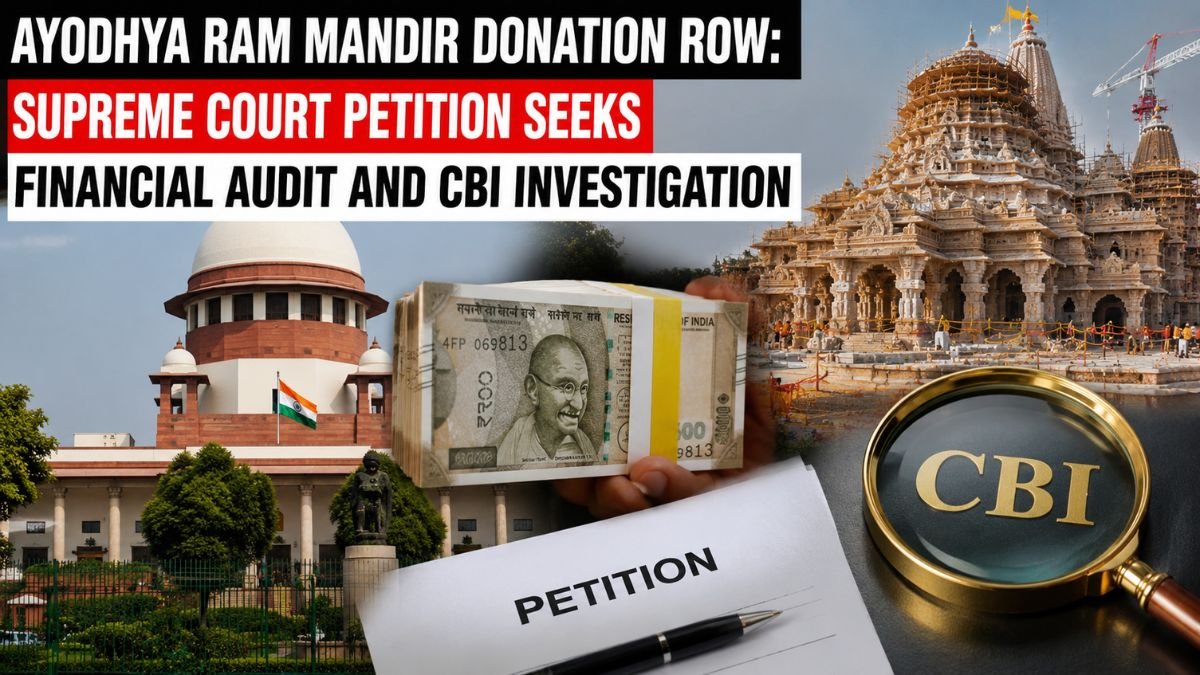
A new legal debate has recently emerged regarding the financial affairs of the Ram Mandir Trust in Ayodhya. A petition filed in the Supreme Court seeks an independent audit of the Trust's financial activities and a probe by the Central Bureau of Investigation (CBI). Following the filing of this petition, the issue has become a subject of discussion across political, legal, and social spheres.
However, it is important to note that the matter is currently sub judice, and the court has not yet reached a final conclusion regarding the allegations raised in the petition. Therefore, all claims should be viewed merely as allegations or the petitioner's standpoint.
Main objective of the petition filed in the Supreme Court
The petition primarily seeks an independent inquiry into the Ram Mandir Trust's financial management and the utilization of donation funds. The petitioner argues that if any suspicion or dispute has arisen, an impartial investigation should be conducted to clarify the facts. A CBI probe has also been requested to uncover the truth regarding any potential irregularities. However, until the court issues an order, these demands will be treated merely as requests currently under judicial consideration.
What is the significance of the demand for a financial audit?
Maintaining transparency regarding donations received and their utilization is considered crucial for any major religious or public trust. The purpose of an independent financial audit is to examine accounts, income and expenditure, and financial processes to ensure that all transactions comply with regulations. Experts believe that if questions are raised about an organization, an independent audit can help clarify the situation. However, a mere demand for an audit does not imply that any irregularity has been proven.
Why was the demand for a CBI probe raised?
The petition also requests an investigation by the central investigative agency. Generally, demands for a CBI probe arise when there is a perceived need for an independent and comprehensive investigation into a matter. However, the decision to order a CBI probe rests with the court or is determined by the relevant legal process. In this matter as well, the nature of further action required will depend entirely on the court's discretion and the available facts.
Role of the Trust and the Donation System
The Ram Mandir Trust was constituted to oversee the temple's construction and manage the associated administrative and financial operations. Devotees from across the country and abroad have been making significant donations for the temple's construction and other religious activities. Consequently, the Trust's financial management is naturally a subject of public interest. Should any dispute arise, transparency and clear information play a crucial role in reinforcing public trust.
What might happen next in the legal process?
Following the filing of the petition, the court may first conduct a preliminary hearing. Subsequently, responses may be sought from the concerned parties, and the available documents examined. If the court deems it necessary, it may order further investigations, call for reports, or issue other legal directives. Conversely, if the court finds no prima facie grounds, a different decision regarding the petition could be reached. Thus, the final outcome will depend entirely on the judicial process.
Political and Public Reactions
In such matters, political parties and social organizations often express their respective views. Some may support demands for an inquiry to ensure financial transparency, while others might argue that one should await the court's verdict before drawing conclusions. Diverse reactions to this issue are also visible on social media. However, in any democratic system, respecting the judicial process is considered paramount.
Social Media and the Need for Factual Information
In today's era, news related to legal or political matters goes viral rapidly on social media. Often, incomplete information or unverified claims are widely circulated. Therefore, experts advise forming opinions on matters pending in court based solely on reliable news sources and official documents. Refraining from rumors or unverified claims is part of being a responsible citizen
Importance of Transparency in Religious Institutions
Donations received by religious and public trusts are deeply linked to the faith of millions of devotees. Therefore, financial transparency, regular audits, and adherence to regulations are considered essential for maintaining the credibility of any institution. Addressing questions raised about an institution through legal and institutional processes is a vital part of a democratic system. This also strengthens public trust.
Conclusion: The final decision rests with the court
The matter concerning demands for a financial audit and a CBI inquiry into the Ayodhya Ram Mandir Trust is currently subject to judicial proceedings. The allegations raised in the petition remain unproven, and a final court verdict is awaited. In such instances, the most appropriate approach is to maintain a balanced perspective, respect the facts and the judicial process, and await official information. Future Supreme Court hearings and directives will determine the course of this entire matter. Until then, the issue should be viewed strictly as a legal dispute sub judice, and one should refrain from rushing to any conclusions.
Related News