U.S. Supreme Court Upholds Birthright Citizenship, Rejects Trump’s Proposed Restrictions
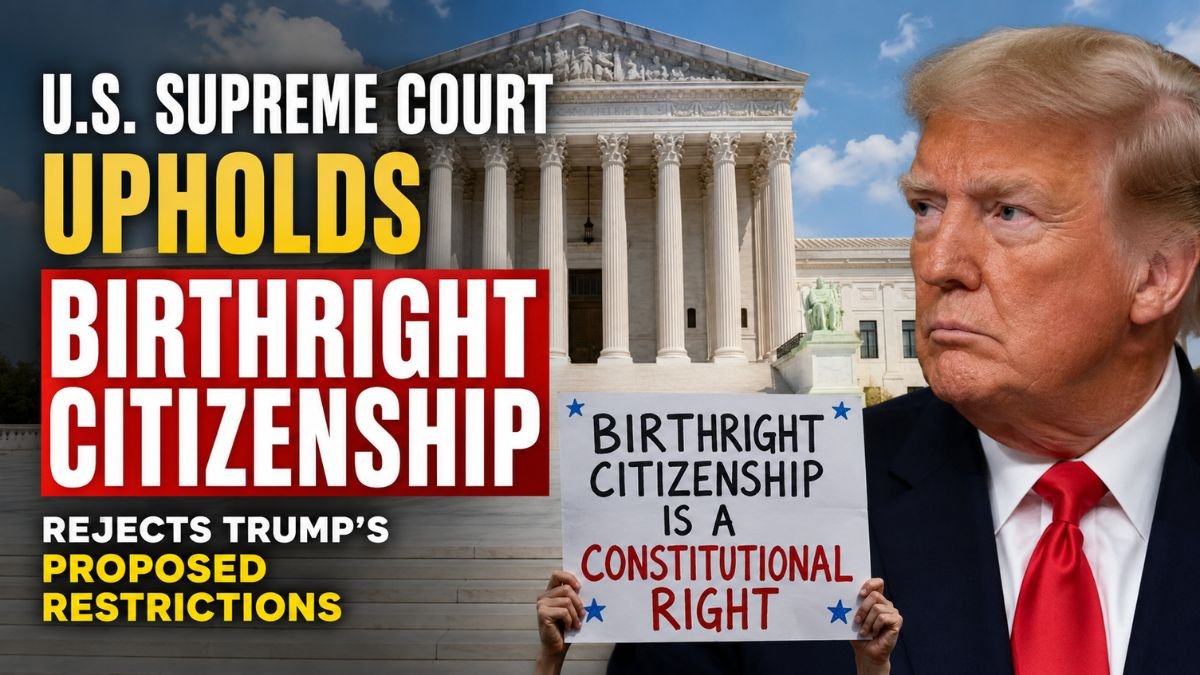
The recent US Supreme Court ruling is considered highly significant for the country's constitutional framework and immigration policy. While upholding the principle of birthright citizenship, the Court rejected restrictions proposed by former President Donald Trump that aimed to curtail this system.
This decision has sparked a fresh debate in the US regarding the Constitution, civil rights, and immigration laws. Legal experts believe that the ruling extends beyond the immediate dispute and will serve as a crucial precedent for citizenship-related matters in the years to come.
What is birthright citizenship?
Birthright citizenship simply means that if a child is born on US soil, they are generally considered a US citizen. This system is rooted in the 14th Amendment to the US Constitution, which was enacted following the Civil War. The provision was intended to ensure that individuals born in the US enjoy equal civil rights. For years, this principle has remained a cornerstone of US citizenship law, making it a frequent subject of political and legal debate.
What changes did the Trump administration seek?
Former President Donald Trump had long argued that the existing birthright citizenship system was open to abuse. He believed that granting citizenship solely based on birth on US soil was inappropriate, particularly in cases where the parents were neither permanent citizens nor legal residents. Driven by this view, efforts were made to limit birthright citizenship.
However, the proposal faced opposition from numerous legal experts, human rights organizations, and opposition leaders. They argued that such a move would violate the fundamental spirit of the Constitution and would be legally extremely difficult to implement
On what grounds did the Supreme Court base its decision?
In its ruling, the Supreme Court clarified that existing constitutional provisions and long-standing legal interpretations cannot be disregarded. The Court emphasized that any significant alteration to constitutional rights regarding citizenship requires a robust legal basis. Many experts view this court ruling as a safeguard for constitutional continuity and judicial tradition. It is also perceived that the court prioritized constitutional principles while remaining aloof from political debates.
What impact will this ruling have on US immigration policy?
Although this ruling does not directly alter the entire immigration system, it could certainly influence future policies. The preservation of birthright citizenship means the current citizenship framework will continue as before. However, debates regarding border security, illegal immigration, and visa policies in the US are likely to persist.
Experts believe that while future administrations might attempt to modify immigration policy through other legal and administrative measures, the issue of birthright citizenship will remain under constitutional protection for the time being.
Varied reactions to the ruling within the political landscape
Following the decision, reactions from US political parties and various organizations were mixed. Several civil rights groups welcomed the ruling, hailing it as a victory for the Constitution and the principle of equality. Meanwhile, some conservative leaders maintained that the US immigration system still requires reform.
Political analysts believe this issue could remain a key topic in upcoming elections, given that citizenship and immigration have long been central to American politics.
What does this mean for ordinary citizens and immigrant families?
This ruling brings significant relief to families living in the US whose children were born there. The retention of birthright citizenship implies there will be no immediate changes to the existing legal framework. While the ruling does not resolve every immigration-related issue, it substantially reduces uncertainty regarding citizenship.
Legal experts advise individuals to consult authorized immigration advisors or attorneys based on their specific circumstances, as each case may differ.
Why is the ruling being discussed internationally?
The United States is one of the most influential nations in the world; consequently, the entire globe keeps a close watch on major rulings by its Supreme Court. The issue of birthright citizenship has been a subject of discussion in many other countries as well, given that citizenship rules vary across nations.
While some countries grant citizenship based on the place of birth, in many others, it depends on the parents' citizenship. Against this backdrop, this US Supreme Court ruling could influence legal and political debates on a global scale.
What legal and political challenges might lie ahead?
Although the Supreme Court has delivered its verdict, the debate surrounding citizenship and immigration will not end here. Future administrations may attempt various policy changes, and Congress could also deliberate on new bills concerning citizenship and border security.
Should any new law or constitutional amendment be proposed in the future, the possibility of legal review would remain. Consequently, this issue will continue to be a significant part of American politics and the judicial system in the years to come.
Conclusion: A Significant Ruling on the Constitution and Civil Rights
This US Supreme Court ruling is viewed not merely as a legal decision, but as a pivotal step in interpreting the Constitution and shaping the course of civil rights. By upholding birthright citizenship, the Court has signaled that altering the fundamental principles of the Constitution is no easy task.
At the same time, the case illustrates how the balance between the judiciary, the executive, and the legislature in the United States strengthens the democratic system. While political debate over immigration and citizenship may persist, this Supreme Court ruling has, for now, reinforced the existing system of birthright citizenship. This is why the decision is regarded as one of the most significant constitutional rulings in recent American history.
Related News