Ayodhya Advocates Step Back From Representing Accused in Ram Temple Case
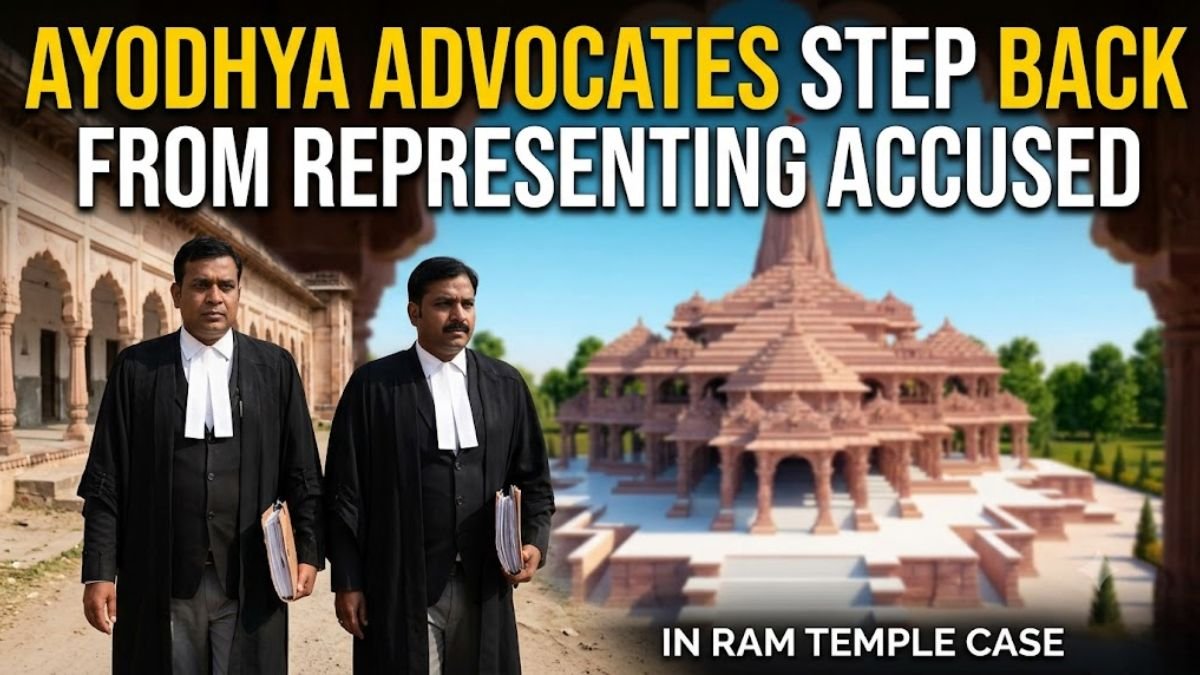
A case related to the Ram Mandir in Ayodhya has recently sparked significant discussion at both legal and social levels. According to reports, some local lawyers have decided against defending the accused in this matter. Following this move by the lawyers, the case has transcended the courtroom to become a topic of public discourse. As the Ram Mandir is a site of immense faith for millions of people across the country, any dispute or legal matter concerning it draws close public attention.
This entire episode has once again raised the question of how to strike a balance between the law, social sentiments, and the judicial process in sensitive cases. However, the veracity of allegations against any individual is established only after an investigation and the due process of the court.
Why the lawyers' decision sparked discussion
In any legal matter, the accused has the right to present their side, and the role of a lawyer is integral to the judicial process. However, when a case becomes religiously or socially sensitive, decisions related to it attract greater attention. It is for this reason that the decision by some Ayodhya-based lawyers not to represent the accused has triggered widespread discussion
A lawyer's decision to take up or decline a case depends on personal judgment, circumstances, and perspective. In this instance, too, the lawyers' move is being viewed from various angles; some link it to social sentiments, while others regard it simply as a decision pertaining to the legal profession
Sensitivities surrounding the Ram Mandir
The Ram Mandir is one of India's most prominent religious sites. Ayodhya has long held significance from both historical and religious perspectives. Since the construction of the temple, any news—major or minor—related to it captures public attention
This is why there is keen public interest in any financial, administrative, or legal dispute concerning the temple. People expect transparency in all temple-related affairs and demand an impartial investigation should any irregularities come to light.
Legal Rights and the Importance of a Fair Hearing
A fundamental principle of the Indian judicial system is that every individual must have the opportunity for a fair hearing. Any accused person has the right to present their case in court, regardless of the gravity of the matter.
If a local lawyer refuses to take up a case, it does not mean the accused has run out of legal avenues; they can seek legal assistance through other means. The court's objective is always to deliver a verdict based on facts, evidence, and the law.
Investigation of Allegations and the Process of Uncovering the Truth
The investigation process plays a crucial role in such cases. Drawing a conclusion based solely on allegations is considered inappropriate. It is the evidence gathered by investigative agencies, documents, and witness statements that determine the true nature of the case
If the allegations are substantiated, legal action follows; conversely, if they are not proven, the accused may be granted relief. Therefore, it is essential to have faith in the impartial investigation and the judicial process.
Diverse Reactions in Society
Varied reactions are being observed in society regarding this Ayodhya case. Some people view the lawyers' decision through the lens of faith associated with the temple, while others understand it from the perspective of legal rights.
Emotions are naturally intertwined in such matters, yet in a democratic system, the legal process takes precedence. Maintaining awareness and restraint within society is vital to ensure that no injustice occurs and the actual truth comes to light.
Demand for Transparency in Temple-Related Matters
Transparency is a primary expectation regarding major religious and public institutions. Devotees desire that all financial and administrative operations concerning the temple be conducted in a clear and open manner
An institution's credibility is strengthened only when accountability and clarity are maintained in its functioning. Investigations into such matters are crucial not merely to resolve disputes but also to uphold public trust.
Role of the Police and Administration
The responsibility of the police and administration increases significantly in such sensitive cases. They are required to conduct an impartial investigation, free from any pressure, and must provide all parties with an opportunity to present their case.
Besides maintaining law and order, the administration must also ensure that the situation does not deteriorate due to rumors or misinformation. Public trust can only be sustained through accurate information and transparent action.
Awaiting Further Legal Action
All eyes are currently fixed on the direction the case takes next. Court proceedings, the investigation report, and the eventual verdict will determine the actual outcome of the matter.
It is essential to avoid haste in such matters. The judicial process may take time, but the final verdict must be based solely on facts and evidence. This is the hallmark of a robust democratic system.
Conclusion: A Balance Between Law and Belief is Essential
The incident where some lawyers withdrew from representing an accused person in the Ayodhya Ram Mandir case has sparked legal and social discourse. This case demonstrates that certain issues are not confined to the courtroom alone but are deeply intertwined with societal sentiments and beliefs
Only the investigation and the judicial process will reveal the true nature of the case in the future. What matters is that every party receives a fair opportunity and the verdict is based on the law. Transparency, accountability, and justice play a pivotal role in cases concerning sites of historic significance, such as the Ram Mandir.
Related News